
I can’t change my son’s story. I’ve made my peace with that.
Check out Dr. Zadeh's full pregnancy preparation insights at his substack: beforeconception.substack.com
But I can do the one thing I wish someone had done for me: hand you the short, plain list I never got. Not a theory. Not a debate. Just the handful of things that are almost entirely inside mainstream medical guidance — the version every reader can act on this week, no matter where they land on anything else in this newsletter.
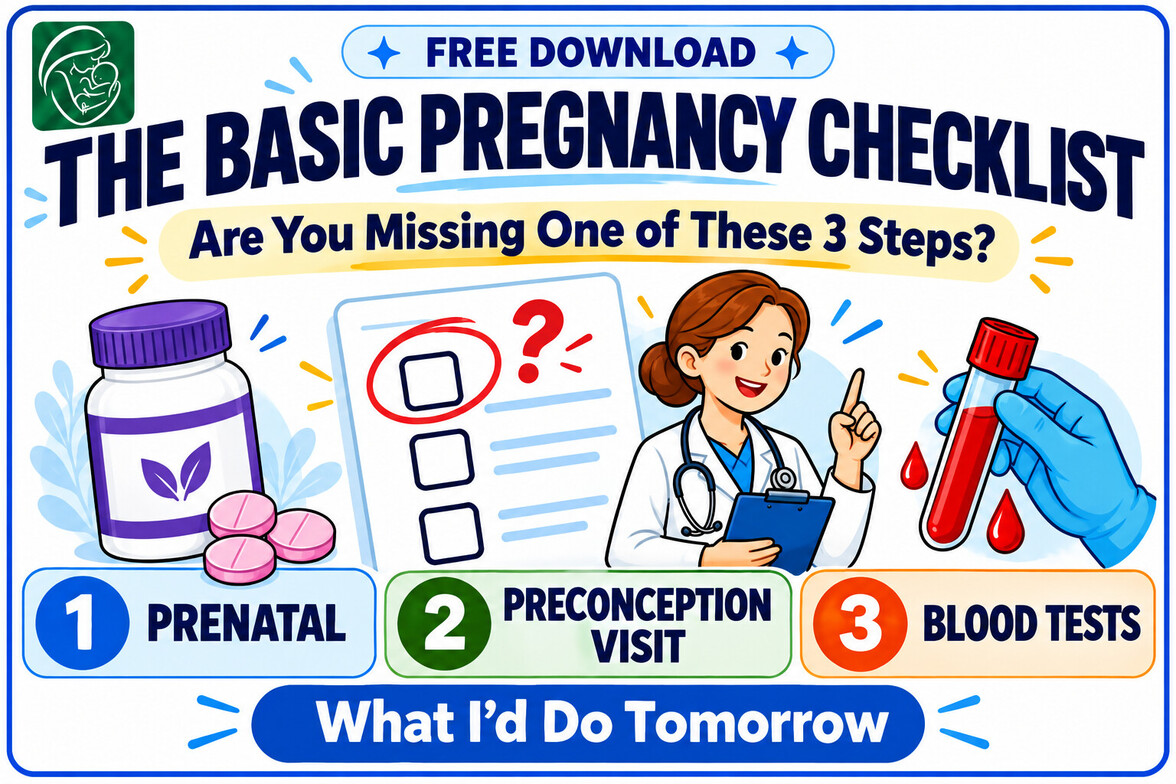
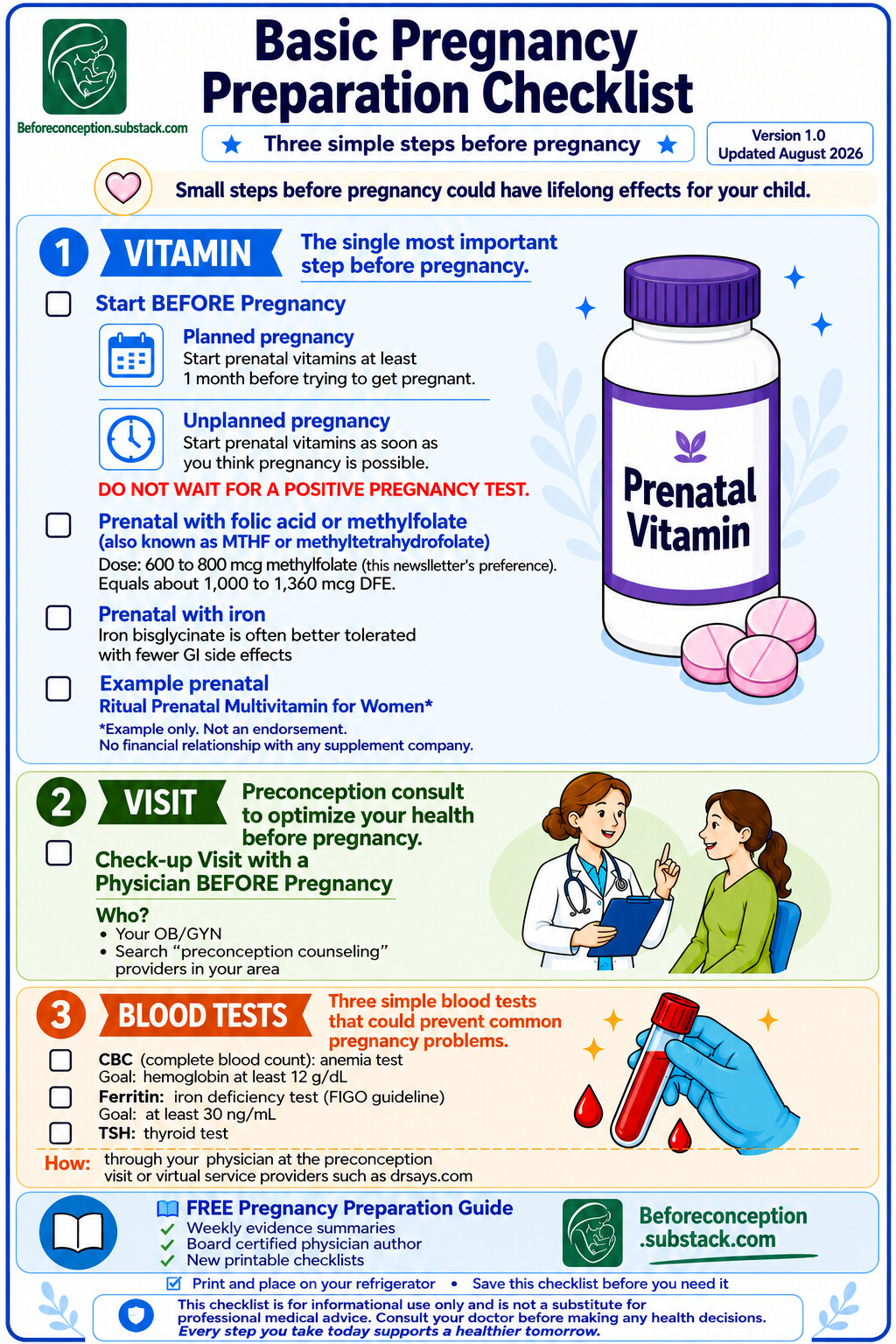
So here it is. The whole basic checklist, free to download below, and the five things on it that matter most.
1. Start a prenatal before you’re pregnant
This is the highest value move in the entire series, and it can cost as little as ten dollars a month. Don’t wait for a positive test — by the time one shows up, the most important early construction may already be done. For planned pregnancies, start prenatal vitamins at least one month before you start trying to get pregnant. For unplanned pregnancies, start prenatals within a day or so after you think pregnancy is even just a possibility, the sooner the better. Do not wait for a positive pregnancy test.
Remember the number that stopped me cold: in the Boston Birth Cohort, only 4.3% of mothers started prenatal vitamins before pregnancy. The recommendation has existed since the 1990s. Most do not follow it. Be the exception — it may be the easiest exceptional thing you can do. [1]
2. Make it a complete prenatal, with enough folate
Not a bare folate tablet. A full prenatal. Aim for at least 600 micrograms of folate — I lean toward methylfolate (listed as L-methylfolate, 5-MTHF, or MTHF), but folic acid is also an option— plus iron, B12, vitamin D, iodine, choline, and DHA. As we saw with the Danish, Swedish and American studies, it may be the whole formulation, not folate alone, that does the work. So don’t skimp to a single-nutrient pill.
One label detail that trips up almost everyone. US supplement labels list folate in Dietary Folate Equivalents (mcg DFE). Because of the conversion, 600 micrograms of actual folic acid or methylfolate appears on the label as roughly 1,000 mcg DFE. The conversion is 1.7. So a bottle reading “600 mcg DFE” contains only about 350 micrograms of actual folate — well short of the target.
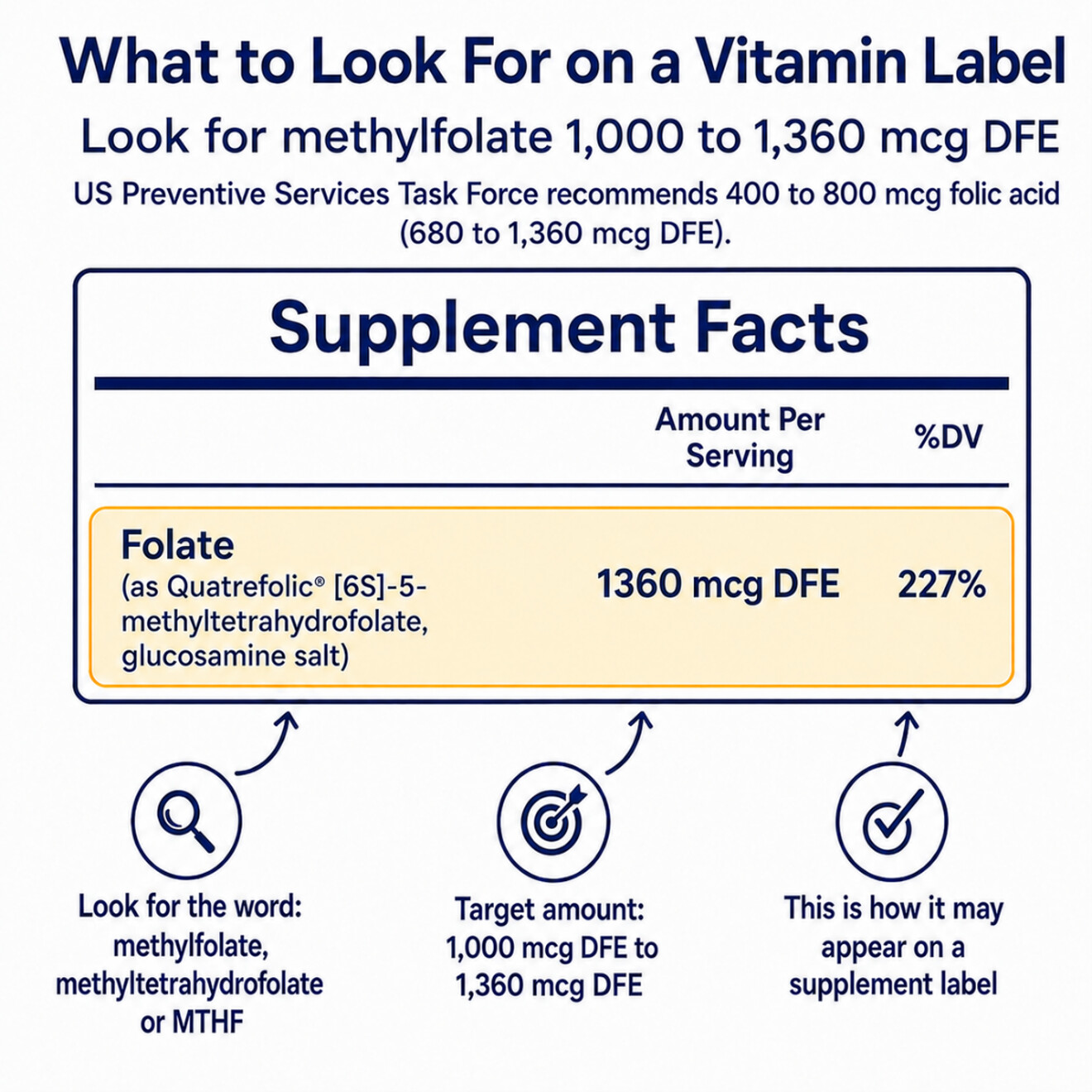
Two more things worth remembering: the folate that counts here is the kind in a supplement — folate from food is fragile and doesn’t substitute reliably. And more is not better; a sensibly dosed prenatal started early beats an expensive megadose started late. For quality, look for USP, NSF, or Clean Label Project verification, or a product made in a cGMP-compliant facility with third-party testing. Any complete prenatal meeting these criteria will do — the checklist names an example, Ritual, but the criteria matter more than the brand.
To be clear, the US Preventive Services Task Force and effectively every government internationally recommend folic acid specifically. So this newsletter’s preference for methylfolate instead of folic acid is just slightly outside the mainstream. [2, 5, 6, 7, 8, 9]
However, researchers have argued for the switch. [10, 11] Regulatory agencies specifically permit methylfolate instead of folic acid for prenatal vitamins. [12, 13, 14, 15, 16] And about 15% of commercial prenatals in the US contained only methylfolate as of 2022, a percentage that seems to keep growing. [11] In fact, half of the top 10 best selling prenatals on Amazon contained the methylfolate option on my last check (in 2026).
This newsletter also focuses on autism. The primary potential benefit of methylfolate over folic acid has autism implications specifically so I do feel the need to include this minor variation. [11, 17, 18, 19]
3. Book a preconception visit
The appointment almost nobody schedules but everybody should. A short visit with a clinician a few months before you try getting pregnant lets you review medications, check labs to evaluate for common conditions such as hypothyroidism or iron deficiency, and get any chronic condition — thyroid, blood pressure — well controlled before pregnancy rather than scrambling after. Your OB/GYN can do this, or you can search for “preconception counseling” providers.
4. Check a few key labs early
Three simple blood tests, all worth doing before you conceive because all three can find common, often asymptomatic, and fixable conditions:
• CBC — a basic anemia check. Goal hemoglobin at least 12 g/dL. [20]
• Ferritin — your iron stores, which can be low even when a standard blood count looks perfectly normal. A common guideline goal is at least 30 ng/mL. (This is the one I’d least want you to skip — and when you read the iron information I’ve been promising, you’ll understand why iron is getting its own post.) [21, 22]
• TSH — a simple thyroid test mostly to catch hypothyroidism that can quietly affect fertility and early pregnancy, and is very treatable. Universal TSH screening is slightly outside most guidelines, but in the real world most endocrinologists do universal screening. [23] And one of the world’s leading experts openly calls for universal screening. [24] Uncontrolled hypothyroidism has also been associated with a higher autism rate, whereas controlled hypothyroidism has not. [25] So I side with common practice, just get a TSH on everyone.
Treat what’s treatable before you conceive, not after.
5. The quiet basics that matter most
None of these is dramatic. All of them are well established: a Mediterranean-style diet, a healthy weight range, no smoking or vaping, and understanding your cycle — for both partners. On alcohol, my advice is to stop rather than cut back while you’re trying, since you can be pregnant for weeks before a test knows it and no safe amount has been established in those earliest days. [26] Preconception health is a two-person project, and sperm quality matters too. These simple steps can improve sperm. [27]
That’s the whole basic version
If you did only these five things, you’d already be ahead of where I was as a physician — and squarely inside mainstream medical guidance or common practice. Nothing here requires you to accept a single one of my more debated ideas. It’s just good, standard, quietly powerful preparation.
Download the checklist. Take it to your doctor. And if it seems useful, hand it to one other person who’s thinking about starting a family. This message travels person to person, or it doesn’t travel at all.
There is a deeper version I would use for my own family. Next time, I’ll show you the whole thing — including the one idea that goes a step beyond the guidelines, and exactly why I think it’s worth considering.
— Jeff Zadeh, M.D. General education from one physician’s perspective, not medical advice. This checklist is informational and not a substitute for professional care. The author has no financial relationship with any supplement company. Please make decisions with your own clinician.
References
[1] Raghavan R, Riley AW, Volk H, Caruso D, Hironaka L, Sices L, Hong X, Wang G, Ji Y, Brucato M, Wahl A, Stivers T, Pearson C, Zuckerman B, Stuart EA, Landa R, Fallin MD, Wang X. Maternal multivitamin intake, plasma folate and vitamin B12 levels and autism spectrum disorder risk in offspring. Paediatr Perinat Epidemiol. 2018;32(1):100–111. doi:10.1111/ppe.12414. Free full text. (Boston Birth Cohort.)
[2] US Preventive Services Task Force. Folic acid supplementation to prevent neural tube defects: US Preventive Services Task Force reaffirmation recommendation statement. JAMA. 2023;330(5):454–459. doi:10.1001/jama.2023.12876. Published online August 1, 2023.
[3] Schmidt RJ, Tancredi DJ, Ozonoff S, Hansen RL, Hartiala J, Allayee H, Schmidt LC, Tassone F, Hertz-Picciotto I. Maternal periconceptional folic acid intake and risk of autism spectrum disorders and developmental delay in the CHARGE (CHildhood Autism Risks from Genetics and Environment) case-control study. Am J Clin Nutr. 2012;96(1):80–89.
[4] Schmidt RJ, Iosif AM, Guerrero Angel E, Ozonoff S. Association of maternal prenatal vitamin use with risk for autism spectrum disorder recurrence in young siblings. JAMA Psychiatry. 2019;76(4):391–398. (MARBLES.)
[5] Wilson RD, et al.; Genetics Committee. Pre-conception folic acid and multivitamin supplementation for the primary and secondary prevention of neural tube defects and other folic acid-sensitive congenital anomalies. J Obstet Gynaecol Can. 2015;37(6):534–552. doi:10.1016/S1701-2163(15)30230-9. Source [6] Toriello HV; Policy and Practice Guideline Committee of the American College of Medical Genetics. Policy statement on folic acid and neural tube defects. Genet Med. 2011;13(6):593–596. doi:10.1097/GIM.0b013e31821d4188.
[6] Toriello HV; Policy and Practice Guideline Committee of the American College of Medical Genetics. Policy statement on folic acid and neural tube defects. Genet Med. 2011;13(6):593–596. doi:10.1097/GIM.0b013e31821d4188.
[7] World Health Organization. Guideline: optimal serum and red blood cell folate concentrations in women of reproductive age for prevention of neural tube defects. Geneva: WHO; 2015. This guideline addresses population folate concentrations; the WHO periconceptional recommendation below states the supplement dose directly.
[8] World Health Organization. Periconceptional folic acid supplementation to prevent neural tube defects. e-Library of Evidence for Nutrition Actions. Accessed October 5, 2026. Source Recommends 400 micrograms of folic acid daily from the start of trying to conceive until 12 weeks of gestation.
[9] Samaniego-Vaesken ML, Morais-Moreno C, Carretero-Krug A, et al. Supplementation with folic acid or 5-methyltetrahydrofolate and prevention of neural tube defects: an evidence-based narrative review. Nutrients. 2024;16(18):3154. doi:10.3390/nu16183154. Source The review identifies no clinical trial establishing that 5-MTHF supplementation prevents neural tube defects.
[10] Obeid R, Holzgreve W, Pietrzik K. Is 5-methyltetrahydrofolate an alternative to folic acid for the prevention of neural tube defects? J Perinat Med. 2013;41(5):469–483. doi:10.1515/jpm-2012-0256.
[11] Tate C, Shuman A, Nice S, Salehi P. The critical role of folate in prenatal health and a proposed shift from folic acid to 5-methyltetrahydrofolate supplementation. Georgetown Medical Review. 2024;8(1). doi:10.52504/001c.124570. Source A review advocating a switch, not a trial of clinical outcomes.
[12] US Food and Drug Administration. Pharmacology/toxicology review and evaluation, NDA 22-532. 2010:9 (PDF page 15). Source Records the 1999 GRAS expert-panel conclusion and June 2001 new dietary ingredient status for levomefolate calcium. These address ingredient safety and regulatory history, not proof of prevention outcomes.
[13] European Commission. Commission Regulation (EU) 2015/414 of 12 March 2015 amending Directive 2002/46/EC as regards (6S)-5-methyltetrahydrofolic acid, glucosamine salt used in the manufacture of food supplements.
[14] EFSA Panel on Nutrition, Novel Foods and Food Allergens (NDA). Conversion of calcium-L-methylfolate and (6S)-5-methyltetrahydrofolic acid glucosamine salt into dietary folate equivalents. EFSA Journal. 2022;20(8):e07452. doi:10.2903/j.efsa.2022.7452. Source Proposes a 1.7 DFE conversion factor for 5-MTHF below 400 micrograms/day and 2.0 for supplements providing at least 400 micrograms/day. Bioavailability is not evidence of superior clinical outcomes; this is not the US labeling rule.
[15] Food Standards Australia New Zealand. Australia New Zealand Food Standards Code—Schedule 17—Vitamins and minerals. Accessed October 5, 2026. Source Lists permitted vitamin forms, including calcium L-5-methyltetrahydrofolate; the relevant schedule is 17, not 15.
[16] Therapeutic Goods Administration. Folate and folic acid for use in listed medicines. January 19, 2017. Source Permits levomefolate salts as ingredients, but does not automatically extend folic acid neural tube defect advertising permissions to them.
[17] Raghavan R, Selhub J, Paul L, Ji Y, Wang G, Hong X, Zuckerman B, Fallin MD, Wang X. A prospective birth cohort study on cord blood folate subtypes and risk of autism spectrum disorder. Am J Clin Nutr. 2020;112(5):1304–1317. doi:10.1093/ajcn/nqaa208. Source Observational cord-blood analysis, not a comparison of methylfolate versus folic acid supplements. Higher unmetabolized folic acid was associated with ASD; 5-MTHF was not. This does not establish that replacing folic acid reduces autism risk.
[18] Cochrane KM, Elango R, Devlin AM, Mayer C, Hutcheon JA, Karakochuk CD. Supplementation with (6S)-5-methyltetrahydrofolic acid appears as effective as folic acid in maintaining maternal folate status while reducing unmetabolised folic acid in maternal plasma: a randomised trial of pregnant women in Canada. Br J Nutr. 2024;131(1):92–102. doi:10.1017/S0007114523001733. Source Measured folate biomarkers, not autism or neural tube defect outcomes.
[19] Draicchio F, Hausser J, Sharafi M, et al. Using 6S-5-methyltetrahydrofolate instead of folic acid in prenatal multivitamin reduces unmetabolized folic acid concentrations in the mother-fetus dyad: a 24-week randomized controlled trial. Front Nutr. 2026;13:1679067. doi:10.3389/fnut.2026.1679067. Source Biomarker trial, not an autism-outcome trial. Funded by Ritual; the multivitamins differed in folate dose and other nutrients as well as folate form.
[20] World Health Organization. Haemoglobin concentrations for the diagnosis of anaemia and assessment of severity. Geneva: WHO; 2011. WHO/NMH/NHD/MNM/11.1. Source The 12 g/dL threshold cited here applies to nonpregnant women.
[21] FIGO Working Group on Good Clinical Practice in Maternal–Fetal Medicine. Good clinical practice advice: iron deficiency anemia in pregnancy. Int J Gynaecol Obstet. 2019;144(3):322–324. doi:10.1002/ijgo.12740. Source The ferritin threshold concerns iron deficiency in pregnancy; it is not a universal preconception treatment target.
[22] Sholzberg M, Hillis C, Crowther M, Selby R. Diagnosis and management of iron deficiency in females. CMAJ. 2025;197(24):E680–E687. doi:10.1503/cmaj.240570.
[23] Toloza F, Singh Ospina N, Rodriguez-Gutierrez R, O’Keeffe D, Brito J, Montori V, Maraka S. MON-586 Practice variation in the management of subclinical hypothyroidism during pregnancy: results from a national survey of endocrinologists in the US. J Endocr Soc. 2019;3(Suppl 1):MON-586. doi:10.1210/js.2019-MON-586. Conference abstract; 154 respondents, 53% reporting universal screening.
[24] Stagnaro-Green A, Dong A, Stephenson MD. Universal screening for thyroid disease during pregnancy should be performed. Best Pract Res Clin Endocrinol Metab. 2020;34(4):101320. doi:10.1016/j.beem.2019.101320.
[25] Elbedour L, Weinberg M, Meiri G, Michaelovski A, Menashe I. Maternal thyroid hormone imbalance and risk of autism spectrum disorder. J Clin Endocrinol Metab. 2026;111(5):e1412–e1420. Published online November 25, 2025. doi:10.1210/clinem/dgaf596.
[26] Centers for Disease Control and Prevention. About alcohol use during pregnancy. Accessed October 5, 2026.
[27] Szabó A, Nyirády P, Kopa Z. Impact of lifestyle and environmental factors on fertility. Curr Opin Urol. 2025;35(6):685–690. doi:10.1097/MOU.0000000000001339. Source

Jaffar Zadeh
Contact Me